Check out music from Caroline Casey & the Stringslingers


Friday, June 17, 2011

ABOUT: Goldie Hill


HILL, ARGOLDA (GOLDIE) VONCILE. (1933 – 2005). Goldie Hill was a Texas-born country music singer frequently billed as “The Golden Hillbilly” (and in her later career, as “Goldie Hill Smith”). She was one of the first female country music singers to make theTop 10 Billboard charts in the early 1950s, and was a regular performer on the Louisiana Hayride as well as a performer and member of the Grand Ole Opry. She was also the second wife of country music star Carl Smith.

Goldie Hill was born on January 11, 1933 in Karnes City, Texas to John Thomas (J.T.) and Effie May Hill (née Davis). She was the only girl and the youngest of four children: Daniel J. (b. 1924), Kenith “Kenny” Charles (b. 1927), and John Thomas “Tommy” Hill (b. 1929). Hill spent her early life in rural Texas, picking cotton alongside her older brothers on their parents' cotton farm. By the mid 1940s her older brothers Kenny and Tommy determined to try their luck making music, and secured positions playing in nearby San Antonio as “The Texas Hillbillies,” vocally and instrumentally backing up Red River Dave McEnery and country singer Weldon E. Lister, better known as six-foot-seven ‘Big Bill’ Lister, “Radio's Tallest Singing Cowboy.” During their stint with Lister, music and comedy performer Smiley Burnette discovered the pair and invited them to California to become singing cowboy extras on some of his films. The venture was not successful for Tommy and Kenny, however, so they returned to Texas the following year and resumed their musical endeavors.

Upon their return, 17-year-old Goldie began to attend their shows, occasionally joining them on vocals. Kenny and Tommy began to make connections with more established musicians who toured through the San Antonio area and by 1951, Tommy Hill had obtained a position as the fiddle player in Louisiana Hayride star Webb Pierce's regular band. It is Pierce, along with her brother Tommy, to whom Goldie Hill attributed her “official” start as a country music singer. In a 1988 interview with Terry Pitcox, Hill recounted the experience. “It was actually 1952, and my brother Tommy Hill was working with Webb Pierce. Kitty Wells had come out with her records and had something pretty good, and Webb decided he needed a girl singer in the band. My brother said, ‘I got a little sister at home.’ He gave me a call and said, ‘Do you want to sing?’ and I said, ‘Why not?’"

Goldie Hill was 19 years old and had been working for IBM Machines in San Antonio, but she joined the band immediately and began to perform frequently on the KWKH Louisiana Hayride billed as “The Golden Hillbilly.” In June of 1952 she traveled with her brother and the band to Nashville to try her hand at recording on Decca Records (Pierce's record label).

In the wake of Kitty Wells' success with the hit answer song “It Wasn't God Who Made Honky-Tonk Angels” to Hank Thompson's “Wild Side of Life”, Hill's first release was a single entitled “Why Talk to My Heart,” an answer song to Ray Price's “Talk To Your Heart” which was a current hit on the Billboard country charts. It was not a successful single, but she tried again shortly afterward. “Don't Let the Stars Get In Your Eyes” was a 1952 hit song penned by country star Slim Willet. Willet, Ray Price, and Skeets McDonald had all recorded versions of the song, and all versions charted on Billboard in 1952 (later in the year, Perry Como's pop version would prove an even bigger hit). On the heels of its success, Slim Willet and Tommy Hill decided to collaborate, writing an answer song intended for Kitty Wells to sing. However, Goldie Hill recorded “I Let the Stars Get In My Eyes” before Wells could, and soon enough, the “Golden Hillbilly” became the second female country star to hit the Billboard Top 10 country charts (preceded only by Wells).

By September of 1953, Hill made Nashville her permanent home and made the shift from regularly appearing on the Louisiana Hayride to performing on WSN’s Grand Ole Opry, She appeared regularly on the Opry from 1953 to early 1957, and as a guest star on several country music television shows (such as “Country Tune Parade”). During these years she continued to record, releasing several full length albums on the Decca label and garnering a number of country hits, such as “I’m the Loneliest Gal In Town“, and duets with Justin Tubb (“Looking Back to See”, “Sure Fire Kisses” ) and Red Sovine (“Are You Mine?”).

During the course of her career Hill had repeatedly encountered Carl Smith, a young country music singer and songwriter who would eventually become her husband. Hill's personal recollection of their courtship is coyly succinct: “I met Carl in New Orleans, the first time. He was on the same package tour and we said hello. I saw him again at another performance and we said hello. Then I moved to Nashville and we said hello. Then four years later, we didn't have to say hello any longer.”

During the time that Goldie Hill and Carl Smith were saying hello, Smith was married to June Carter with whom he fathered a daughter, Carlene (born in 1955). Smith had left the Grand Ole Opry in 1956 to pursue a brief career as an actor and singer for some Hollywood westerns, but he returned to Nashville in early 1957 and subsequently joined a tour sponsored by Phillip Morris.

His marriage with June Carter had deteriorated, and their divorce in early 1957 dovetailed with Goldie Hill's departure from the Opry, as she joined Carl Smith as an addition to the Phillip Morris tour. According to Hill the tour was originally supposed to be a standard 13-week stour, but turned out to be over seventeen months long; Smith and Hill married in September of 1957 and Carl Jr., Lori Lynn, and Larry Dean were born in quick succession. The three children were raised on the Smiths’ ranch just south of Nashville, during which Smith would spend as much time as possible with the family between his tours and other music engagements (which lasted well into the 1970s).

From 1957 through 1968, Goldie Hill pursued music to a much lesser extent, choosing instead to concentrate on raising a family. She gave almost no live performances after 1957, but continued to record sporadically. In 1959 she charted once on another duet with Red Sovine (“Yankee Go Home”), and in 1961 “Lonely Heartaches” was a minor hit. Every year or two during the early 1960s, Hill would release new recordings and in the late 1960s, she made stronger attempts at reviving her career. But as her husband Carl Smith’s long, illustrious career began to wind down both he and Hill became more involved in ranch life. Smith, already an avid horseman, raised quarter horses for many years and later embarked on a minor second career with “cutting” (an equestrian sporting event where riders on quarter horses compete to separate a cow from a herd).

Hill and Smith lived out the remainder of their years on the Smith ranch with their family. Goldie Hill died in Nashville, Tennessee on February 24, 2005 after a long bout with cancer; Carl Smith followed in 2010.


BIBLIOGRAPHY
Bufwack, Mary A. and Oermann, Robert K. Finding Her Voice: The Illustrated History of Women in Country Music. New York, NY: Henry Holt & Company, 1995.

Gibson, Nathan. The Starday Story: The House that Country Music Built. Jackson, MS: University of Mississippi Press, 2010.

Morris, Edward. “Goldie Hill, the Golden Hillbilly, Dead at 72.” CMT. February 25, 2005. Web, accessed April 26, 2011.

Pitcox, Terry. Legendary Conversations (with a Texas Disc Jockey). New York, NY: Henry Holt & Company, 2010.

Star Route 1963 (feat. Host Rod Cameron). rlp Toronto Studios, Medallion TV. Collection of television episodes. Videocassette, 1998 (Distributor Unknown)

Wadey, Paul. “Goldie Hill (the Golden Hillbilly).” Obituaries, The Independent. March 8, 2005. Web, accessed April 20, 2011.

ABOUT: Ronnie Dawson


DAWSON, RONALD MONROE (Aug 11, 1939 – Sep 29, 2003). Ronald Monroe “Ronnie” Dawson was a Texas rockabilly singer, songwriter and guitarist.

Born in Waxahachie to bandleader and bass player Pinky Dawson (of the Manhattan Merrymakers), Ronnie Dawson's musical career was based almost entirely in Texas, spanning from his early teenage years at the Waxahachie Southern Bible Institute to the months before his death from throat cancer in 2003. At the time of his death, he was considered to be of iconic influence on younger generations of rockabilly musicians.

Although Dawson was raised in a family with a primarily fundamentalist Pentecostal faith, musical talent ran a close parallel. Dawson stated that although he did not see a movie until he was 17, he found himself with a guitar in hand at around age 14. In addition to guitar, Dawson's (now musically retired) father Pinky showed him how to play the mandolin, drums, and bass guitar.

Ronnie Dawson's freshman act was called “Ronnie Dee and the D Men”, featuring his soaring tenor vocals, combined with a stand-out guitar sound based in rhythmic rock and roll with a hint of R&B, which was all the teenage rage in 1956. Within two months of its inception, the band Ronnie Dee and the D Men hesitantly entered (and confidently won) a talent contest for a spot on the popular and long-standing Dallas live radio show, The Big D Jamboree. This win earned the young band multiple appearances on the variety show, which aired from Dallas' Sportatorium, a legendary wrestling arena and music venue.

Ronnie Dee and the D Men were soon signed by Big D Jamboree producer (and Gene Vincent’s manager) Ed McLemore. With his assistance, the band soon recorded their first single on Backbeat Records, “Action Packed,” with a B-side of “I Make the Love.” Radio play for “Action Packed” and their next single (“Rockin' Bones” on the McLemore label) gained steady ground; more recording and television appearance offers arrived in swift succession.

Ronnie Dawson cut a compelling figure onstage; nicknamed “The Blonde Bomber,” he was tall and lanky with a trademark blond flat-top haircut and a wide, mischievous grin. His live performances were electric and acrobatic, such that they could challenge even those of the fiery young Elvis Presley. Dawson, however, frequently contended that his style of performance was taken not from Presley but directly from the dynamic Pentecostal revivals that he still attended.

Before long, star-maker Dick Clark signed the burgeoning young group to his Swan Records label and confirmed them for an appearance on “American Bandstand.” Ronnie Dee and the D Men never got to appear, however, for they had happened to arrive on the scene at the cusp of the “Payola” scandal of the late 1950s. The surrounding hullabaloo cut short their musical plans and consequently, hindered their chances for national stardom.

Undaunted, Ronnie Dawson continued his musical career with the help of some of his new connections. After the inevitable break-up of the D Men, Dawson toured as a featured guitarist with the successful Texas western-swing act, The Lightcrust Doughboys. He also employed his drumming skills for studio sessions of various popular artists at the time, such as Paul and Paula's “Hey Paula” and Bruce Channel's “Hey Baby” (also featuring Delbert McClinton on harmonica).

From 1959 to 1961 Ronnie Dawson recorded on several other labels (including Columbia Records). As was the tradition of many artists of the era, Dawson reinvented himself under new musical personae with several recording pseudonyms like “Commonwealth Jones” and “Snake Munroe.” Dawson commented in a 1980s interview with radio show “The Hound” on Jersey City-based station WFMU that he chose “Snake Munroe” as a pseudonym on Columbia because of his middle name (Monroe) and because he thought that the name “Snake” 'sounded cool.' The song he recorded under the name Snake Munroe, called “Do Do Do”, made waves in the R&B radio play circuit; Dawson said that Columbia was even under the impression that he was a black artist and attempted to market it as such. However, even with the heavy airplay, “Do Do Do” failed to sell enough copies to propel Dawson to further musical success.

The early 1960s marked a transition in Dawson's life both musically and personally. He began a strict health regimen that he maintained for the duration of his lifetime; he also joined popular Dallas-based singing group The Levee Singers which, as the folk movement gained speed, experienced considerable success on nationwide television shows such as “Hootenanny” and “The Danny Kaye Show.” Throughout the 1960s, Dawson stayed in the Dallas area and worked with the Levee Singers until musical trends and other transitions had him beginning a new country-rock band called “Steel Rail” in the early 1970s.

Dawson experienced a good deal of local success with “Steel Rail” throughout the 1970s; it was at this time that he also began doing singing and voice-over work for television commercials. Dawson's deepened voice boomed into households everywhere as a 'down-home' personality touting Jax Beer, Aunt Jemima syrup and Hungry Jack pancake mix.

While Dawson was hard at work keeping himself afloat in the music business in Dallas, younger bands (music revivalists, such as The Cramps) discovered Dawson's material from the 1950s. At the same time, the advent of the 1980s had begun a worldwide sub-cultural movement to “bring back” the older rockabilly artists of the 1950s, primarily by releasing their older cuts on CD and booking them to rockabilly-themed festivals. His early cuts, such as “Rockin' Bones” and “Action Packed,” endeared Dawson to collectors and promoters on the festival circuit worldwide and by the mid 1980s, he found himself a star once again, arguably more than even the small taste of stardom he had experienced in his early years.

Re-releases of Dawson’s early career occurred consistently throughout the 1980s, and in the 1990s, bolstered by his success, he began again to record and release new original material. This time he used a new generation of rockabilly musicians whom he had met during his recent musical forays, all of which possessed a love for recreating the authenticity of the original rockabilly and blues sounds. With a young energetic crew as his backing band, Dawson continued to remain highly active with live performances and recordings for the remainder of his life.

Many music journalists and critics believe that Ronnie Dawson's musical endeavors reached a summit in his later career years rather than his early years, even though he was performing the same style of music (firmly rooted in the country, blues and rockabilly genres) as he had in the 1950s. This continued pursuance of his early music is a departure from other white musical artists who had similar genre-specific careers of the era, and his success at delivering it 30 years later provides a compelling case for his influence on many musicians today.

From the beginning of this resurgence until (and past) his diagnosis of throat cancer in 2002, Ronnie Dawson's music and performances continued to breed new fans worldwide; meanwhile, regional, national and international media touted Ronnie Dawson as a Texas-bred musical legend. Following Dawson’s death on September 23, 2003, numerous memorial shows were held in his honor, all of which contained a moment when the attendees banded together to sing a verse from Dawson’s 1957 rockabilly anthem, “Rockin' Bones.”


Lord, when I die, don't you bury me at all
Just hang my bones up upon the wall
And under them bones let these words be seen:
“Here's the runnin' gears of a boppin' machine!”


BIBLIOGRAPHY

AUDIO SOURCES
Jim Marshall (Host). “The Hound,” radio broadcast interview, September 12, 1987, for WFMU 91.1 Jersey City, NJ. (http://thehound.net/19870912/), accessed January 16, 2010.

Jim Marshall (Host). “The Hound,” radio broadcast interview, May 28, 1988, for WFMU 91.1 Jersey City, NJ. ( http://thehound.net/19880528/ ), accessed January 17, 2010.

Jim Marshall (Host). “The Hound,” radio broadcast interview, June 17, 1989, for WFMU 91.1 Jersey City, NJ.( http://thehound.net/19890617/ ), accessed January 17, 2010.

Jim Marshall (Host). “The Hound,” radio broadcast interview, July 29, 1995, for WFMU 91.1 Jersey City, NJ. (http://thehound.net/19950729/ ), accessed January 20, 2010.

NEWSPAPER
Thor Christensen, “Dallas Singer Ronnie Dawson Dead at 64.” Dallas Morning News, September 30, 2003. ( http://www.actionpackedevents.com/ronniedawson.htm ), accessed on January 22, 1010.

Aaron Howard, “The Big D.” Houston Press, May 10, 2001.( http://www.houstonpress.com/2001-05-10/music/the-big-d/#), accessed January 23, 2010.

Malcolm Mayhew, “Ronnie's Last Song.” Fort Worth Star-Telegram, July 6, 2003.

Robert Meyerowitz, “Late Bomber.” Phoenix New Times, March 13, 1997. (http://www.phoenixnewtimes.com/1997-03-13/music/late-bomber/), accessed January 19, 2010.

Michael E. Young, “Going Down For the Count.” Dallas Morning News, February 22, 2003. As cited in (http://www.rockabillyhall.com/BigD.html), accessed January 21, 2010.

MAGAZINES
Marc Bristol, “Ronnie Dawson” (as cited in a 1998 interview excerpt with David Dennard). Blue Suede News #46, Spring 1999.

Tom Dodge, “The Other End of the Telescope.” Texas Observer, September 5, 2008. (http://www.texasobserver.org/article.php?aid=2841), accessed January 23, 2010.

W. Russell, “Rockin' Ronnie Dawson: The Blonde Bomber.” Kicks Magazine #3, 1984.

INTERNET SOURCES
Ken Burke, “Ronnie Dawson.” Musician Guide Online. (http://www.musicianguide.com/biographies/1608004077/Ronnie-Dawson.html), accessed January 21, 2010.

Monday, July 19, 2010

Family associations - Alan Lomax, Sam Hinton, Pete Seeger


One of the many reasons I remain in love with Austin is because it contains so many amazing relics of Texas cultural history. I find it extra fortuitous that one of my years-long obsessions, the Lomax family, has such an entwined history with the town I love. On Saturday I drove over to the Center for American History at UT, so I could spend some time with the John A. Lomax Family Papers, which are archived there. I don't know how it had escaped me that they have such a great collection here. I suppose I figured that the Library of Congress has everything cool that I'll ever want to write about. But do I live on the East Coast? Nope. Luckily, Texas has enough to keep me happy.


I've been writing a term research paper for one of my history classes; about the history of the cowboy ballad and its place in the development of a folkloric America. It's a basic research paper...not too detailed and only ten pages long. In it I interlace the history of song collection as an early 20th century fascination and tie the collection process itself in with the development of frontier songs, folk ballads and the braggadocio-laden "tall tale" tradition of the American cowboy.


Naturally, as with most music for which I find myself most entranced, I found that the work of John A. Lomax and his son, Alan Lomax, is the hub of this particular cultural wagon wheel (one with many, many spokes). In my paper I used "American Ballads and Folk Songs" by both John and Alan, as well as John Lomax's 1947 personal memoir "Adventures of a Ballad Hunter," to provide good primary sources for both the songs and their systematic documentation.


History by its very definition always an extremely subjective study...and the Lomaxes intentionally (and sometimes inadvertently) shaped our country's musical history with their work. I find their documentation processes compelling, especially when compared to that of my uncle Sam's autobiography, where he outlays his own kind of systematic and scientific approach to both documentation of vaudeville and folk music cultures, and also of biological species that he encountered during his lifetime. What a fount of information, and all just waiting for me to tie it in!


Although the paper is already written and I don't intend to use the John A. Lomax Family Papers as direct source material for said paper, it doesn't really matter. That's just one paper, which doesn't compare to almost fifteen years of intense personal curiosity about the Lomaxes. I had to ask to see some of those boxes.


So here is what I discovered in the Center for American History archives on Saturday:


There are countless (COUNTLESS) handwritten notes by John A. Lomax (whose handwriting is slanted near beyond legibility!) and other individuals. On the back of almost all of these thin, yellowed pages are written the names of the people who contributed the song. Fascinating!


I happily unearthed several drafts of "Adventures of a Ballad Hunter", from roughly-scratched-on paper in that slanty writing to typewritten and proofread pages from the final manuscript. I loved finding out the things that were scratched out and never made it into the book that I so love.


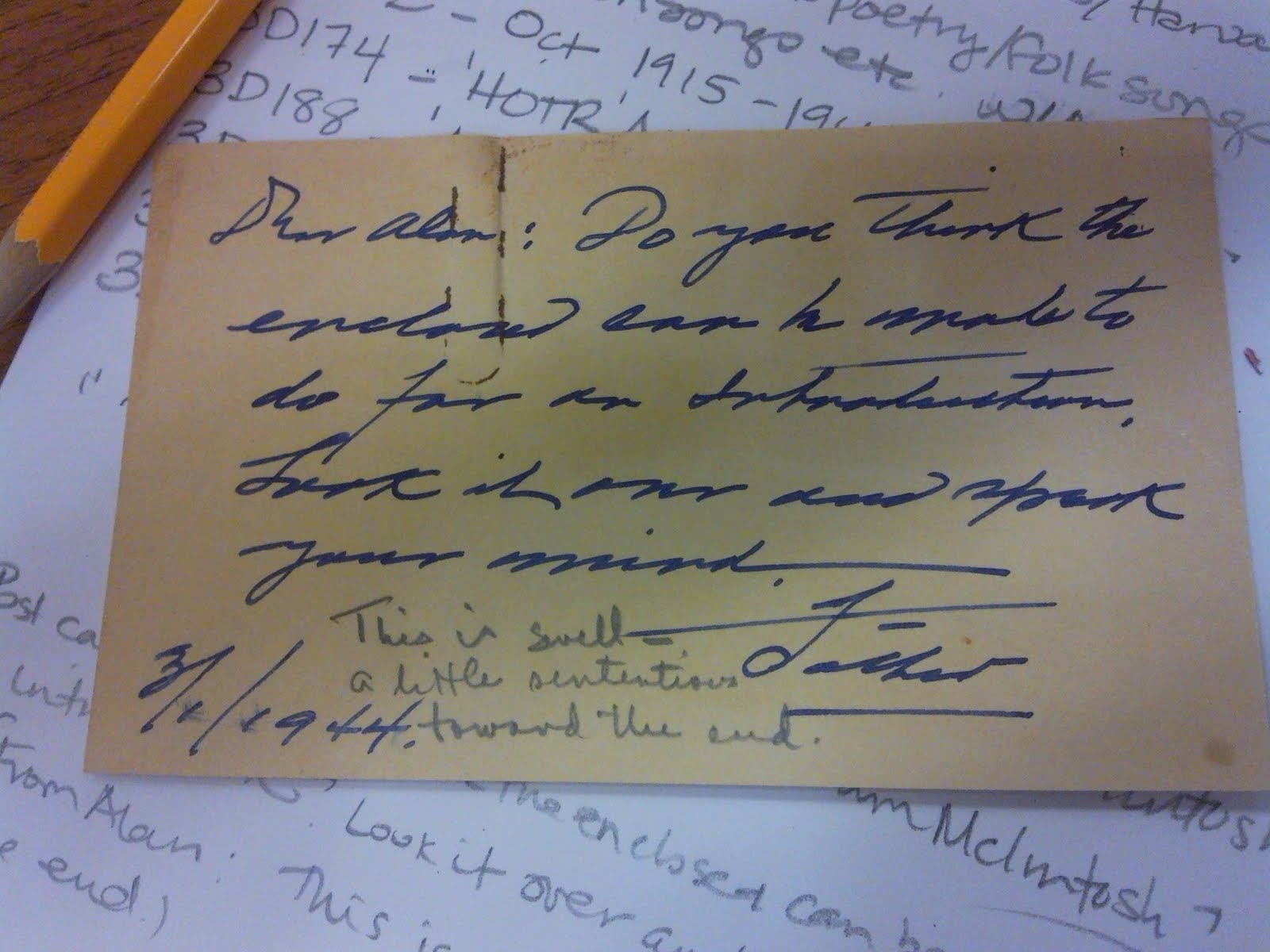
I also found a funny little note from 1944 in which John asked his son Alan for feedback on his draft. See the picture!!!


"Dear Alan: Do you think the enclosed can be made to do for an introduction. Look it over and speak your mind. - Father"


- to which another handwritten note by his (obviously hipper) son, replied:


"This is swell - a little sententious toward the end."


Awesome.


It made me tear up at the obvious mutual respect they had for one another. It made me wish my dad were still living so he could look MY stuff over. God only knows he would love what I'm doing now.


Let's see - what else did I find out? I found out that Alan Lomax had between one and three young women writing to him over a period of ten years (for most of which he was married to Elizabeth Lyttleton Harold). He had a couple of other wives and loves over the years (Shirley Collins being one of them), but none were noted in the signature lines of the letters that *I* read that day.


I was just sort of leafing through everything, trying to keep a snappier pace because there was so damned MUCH of everything and the CAH closed at 2pm. But when I opened Alan's folders and I saw a yellowed paper with a first line that scrawled, "Alan - I got your heartless letter today"...whoa! What?


I found myself embroiled in the seperate dramas of a woman named Faith and a woman named Mishka (although I was writhing with guilty curiosity for a while since the first few of Mishka's letters looked like they were signed "Mike"). The letters were all about their love and admiration for Alan and his having fallen in love with other people...among other anecdotes from which I might gleen some further interesting facts, at a later date. It was rather like seeing an archaic paper episode of "Jerry Springer" - I don't particularly enjoy watching it unfold, but it's too engrossing to ignore!


Another thing which I didn't know (although I should have!) was that John Lomax was good friends and a colleague of Charles and Ruth Seeger, who were also music and cultural historians of the era. What's interesting is that they were in turn the parents of Pete Seeger (and no doubt the source of his starting repertoire).


What's even more interesting is that I had dinner with Pete Seeger when I was a teeneager, because my uncle Sam Hinton was playing a multiple-act folk music bill in Kansas City with Pete Seeger. I know they were lifelong friends. I also know that Alan and Pete knew each other all their lives on account of their parents' friendship, and I knew that Alan and Sam also had a friendship hearkening back almost to when Sam lived in Texas in the 30s (although I think they met after that, in the early to mid 1940s). I talked with Sam after Alan died in 2002, just to see how he was doing. He missed his friend, of course.


I would find it enjoyable and incalculably rewarding to research and write an extensive piece on the history/dynamics of the lives and friendship of Sam Hinton, Alan Lomax and Peter Seeger, who shared a lifelong love of music and folklore and maintained personal and professional associations with one another for almost 50 years. Along with, of course, the help of many sources including the Lomax Family Papers, Sam's autobiography, and Adam Miller's biography (which I have yet to obtain).


I also skimmed over some very lengthy letters from Woody Guthrie to Alan, which also warrant closer scrutiny in the future.


I am so thankful to my father and my father's family for teaching me about Sam and his legacy (and my grandfather Jon Gnagy's too), and for passing on to me a passionate love for history, culture, education and music. I also thank the the powers that be that I now live in a town that enables me t0 drive only 12 minutes to find a dusty, crumbling wealth of information in 40+ closely guarded boxes of papers and photographs that I can touch, smell, and learn from.

Tuesday, June 22, 2010

"A Naturalist in Show Business/I Helped Kill Vaudeville"

So I've been working with TSHA Online to get some assignments that I can really get excited about.

I had suggested Sam Hinton to their research editor because 1) he's my uncle, 2) he's recently deceased (a TSHA rule), and 3) he spent a fair amount of time in Texas.

This was agreed upon so I emailed Leanne, Sam's daughter, to see if she could send me excerpts from one or two of the biographies I had heard were in the works for him. She sent me his unpublished autobiography that he wrote in 2001. It's called "A Naturalist in Show Business (or) I Helped Kill Vaudeville."

FLOORED.

Although this might be considered too esoteric for some, I personally was riveted since page one (of 324). Sam Hinton moved to Texas at the age of 12 in the late 1920s. He worked road construction. He attended Texas A&M. He learned songs from old black sharecroppers. He played with snakes. Early on he decided that his life will be devoted to two things equally: making music, and the study of biological science. And you know what? He did it!

As head of Scripps Aquarium in San Diego, he touched more shark guts than anyone I know personally (I think!)...he also helped father the mid-20th century folk boom. The book is so equally divided that if one were not eager and/or cognizant of the need for some people to fully live two lives (as I am), it might prove tiresome or confusing...only half as interesting. Luckily I'm a zoology nerd as well as a music person, so I'm right there in the fire with him.

Here's an example: Sam will begin a chapter by recounting the cantankerous ramblings of an old vaudeville legend who was sitting on the theater back stoop and kvetching about "the biz"...then just when you start to shake your head in wonder that he even knew such a legend, he segues abruptly into saying "meanwhile, I thought it prudent to walk around the side of the building to the alleyway, where one of the girls had reported seeing a large striped snake by the dumpsters. I found him and it turned out to be a calm-demeanored specimen of Lampropeltis triangulum, or the common Milk Snake...."

Now you have an idea of what I mean. It's amazing...the things he did, the people he met, the things he saw!

Right now I'm also taking a summer class and working on a research paper for said class - about the history of the cowboy ballad. This is great and I can use plenty of the Lomax library (Alan, John, both) about ballad hunting...but really I can't wait to take Sam's autobiography and make some anecdotes known to the public via the TSHA website.

Saturday, May 22, 2010

My Grand Plan

Over the past few years I've simultaneously balanced (or imbalanced) my musical life through several bands, and by researching and writing about musicians from days gone by.

I've known for several years now that I'm at a crossroads in my life; now that I've achieved some stability for myself, I need to make a shift from what I DO do to what I WANT to do. Does that make sense? In a nutshell, I am a musician, music buff and music historian who works at a deliciously cubicle-y day job in Clinical Research.

Luckily, my educational level hasn't seemed to matter much up to this point, as I have been chasing some of these scholastic pursuits and been published numerous times. But the way I see it, it can only go on like that up to a point. I mean, who wants their biography written by someone who doesn't even have an Associates' Degree? I cannot be taken seriously as a historian unless I have the academic creds to back it up. And naturally, I know very little compared to what I need to know... I must learn about it in more depth, not just from Half-Price Books, 'zines and liner notes.

Did I mention I'm also a total academic nerd who loves writing papers, school, deadlines, and all that schtuff?

After my father died in 1997, I wanted to take a break from school and I found myself with my first band. It felt so right, although I was really scared of the possibilities. After some fits and starts, I finally found the group that got me some recognition (The Casey Sisters) and creative satisfaction, and I started to really get on a roll. And then when Swedish record labels came a-knockin,' it was like...forget school! Why not move to Austin, get a record deal, make some albums, play a bunch of festivals and tours in Europe? School will still be there when I get back.

And there I stayed for ten years.

One day about a year and a half ago, I found myself on the website for the Center for Texas Music History (CTMH) at Texas State University - San Marcos. I sat, idly clicking and wishful thinking...until I saw on the webpage that one of my gal pals, a super musician, was listed the Director of Programs for CTMH at TSU-San Marcos. I mean, I hadn't seen her in a while, but DAMN! She had my dream job! I literally got goosebumps and FELT my life change at that moment (even though my butt was sore from sitting in my stupid computer chair).

I wasted no time in contacting her, and we met up soon after. We had a glass of wine and I showed her a few of my writings and told her what I wanted to do with my life, and how I hoped to make the transition. Lo and behold, she got tears in her eyes, said how amazed she was by my interest, and promptly gave me a writing assignment to be published on her website. Ever since she's been my mentor and my cheerleader. I love her.

I've now started planning my education in great detail. While taking core courses at ACC and working full time, I've been planning for a transfer to Texas State in the fall of 2010. My goal is clear: B.A in History, M.A. in Public History. Oh, how I thrill at the thought of taking an Archiving class, or a class on the history of country music, or a class on how to research and write historically-oriented publications. We're talking drooling here.

What were previously my attempts to FEEL like a scholar are now slowly being realized. Rather than just writing for 'zines, I'm now a writer for Texas State Historical Association (TSHA), which is bona fide and has been around since eighteen ninety-fucking-seven. I'm ready!

Once of my articles is about to be posted on TSHA Online; it's about Ronnie Dawson and is the article my friend assigned me last year. The TSHA editor then asked if I would write on another group...and there are more to follow, or so she told me on the phone the other day. What? You got it, lady! So now I'm researching The Levee Singers.

Later on will come some information on a cool idea I had that my mentor says will get me on all the documentaries as a "talking head." Who doesn't want to be a Talking Head? I mean, even David Byrne and Tina Weymouth wanted to at some point. Haha.

Swingin' Back In.....

It's been 3 years since I last posted on my "No Future" music blog. I suppose I should feel ashamed, but I'm not really. Aside from scholastic and work and personal endeavors, I have more blogs, FB and Myspace profiles than I know what to do with.

HOWEVER - my musical life has taken on a lovely new direction, and this blog is now going to chronicle my journey.

Off we go!


Tuesday, December 18, 2007

Here's to you, Uncle Sam!

I'm so excited that someone did a mini-bio on my uncle, Sam Hinton. He's so amazing.


Here's the link:

http://video.google.com/videoplay?docid=-2669329089073228615&q=sam+hinton